Thursday, April 19, 2012

My Consultation with Simone Kaplan

Several weeks ago I entered a contest on Katie Davis' blog in response to her podcast, Brain Burps About Books.  I had actually forgotten about it until one day I received an email from Katie letting me know that I had won something, and I had better listen to her next podcast.  


Sure enough, I tuned in and was quickly reminded that editor, Simone Kaplan, had agreed to generously donate her time for 3, half-hour manuscript consultations.  MY NAME WAS CALLED!!!  I never win anything (except for a game of Bingo on a cruise back in 1995).  I was so excited that I began trying to figure out which manuscript to send in for evaluation.


I selected a manuscript that I have been working on periodically for about 5 years.  I have always loved the quirkiness of the main character. . . Simone did too.  I have always enjoyed her playfulness and individuality. . . Simone did too.  I have always thought that the readers would be anxious to turn the pages. . . Simone did not.


Not only did Simone and I spend a half an hour working together on how to remedy this page turning situation, we spent close to one full hour!  We brainstormed together about a variety of scenarios that the main character could experience.  She helped to break down picture book structure for me in a way that it had not been done before--this really helped me as a visual learner.  


I took copious notes throughout our conversation, and can't wait to get started on revising.  


Do I think that this manuscript is going to turn into something that allows me to purchase a whole fleet of new cars?  No, but I DO think that the experience of reworking this story in a variety of different ways will help me to become a better writer.  After all, as an author I have a vision in my head of what my story is to look and feel like.  The key, however, is relaying that vision to the readers.  If my intentions are not clear to the readers, then I need to do what is necessary to get my story told in an effective way.


Thank you Katie for offering this drawing, I love your podcast and can't wait for the next one.


Thank you so much Simone donating your editorial services, and for taking the time to talk with me this morning.  I know that I learned a lot from you, and I look forward to reintroducing Penelope-Mae to you after she has attended finishing school.

Wednesday, April 18, 2012

Words From the Wise #9 -- Scott Teplin

I must begin this post by apologizing to all of you for the delay in getting it up.  I have had MAJOR computer problems over the last several days, and I am finally back up and running in the technical world again.  Glad to be back, I felt so detached from the world-- amazing how we get addicted to our computers.  


Today I introduce to you a lifelong friend, and I truly mean lifelong since we have known each other since birth, artist Scott Teplin.  Scott and I grew up together in Mequon, Wisconsin, went to college and even lived next door to each other in the dorms one year, and have kept in contact over the years as our lives have changed.  Scott's sense of humor truly comes through in his artwork.  I hope that you enjoy meeting Scott today.


1.  Can you please give a history of how you became an artist, and how you became involved with your book, The Clock Without A Face?
I decided that I wanted to make art while living abroad my junior year in college. I hadn’t taken any art classes in high school, so a few classes in college peaked my interest. Then while studying in London I started to fall in love with the Tate Gallery (the Tate Modern hadn’t been established yet). My second semester was spent in an 18th Century villa in small town outside of Florence. While there I took a studio watercolor class and fell in love with the process of painting on paper. After graduating from Madison with a BS in Art, I moved to a tenement building on the Lower East Side of Manhattan and tried to start my career as an artist. After a year of living very poor, I escaped to do a 2 year MFA program in Seattle, but promptly returned to New York as soon as I was finished. I’ve been here ever since, making art. 

I never even thought about illustrating a children’s book before an editor at McSweeney’s called me to see if I was interested. I had illustrated a couple covers for their books in the past - and I since I liked working with them, I thought it sounded like fun. 


2.  How was your experience working on a book for children different for you than the artwork that you typically do?
When I first moved to New York after college I fell in with a rebellious bunch of book artists and we collaborated often in our tiny cramped studio apartments late into the night. We started a book collective, still going strong called Booklyn. The books we made (I still do) were usually one-of-a-kind pieces of art. Anyway - that’s when I started working collaboratively. The Clock without a Face was a rewarding collaborative experience - mostly because Eli (Horowitz) and Mac (Barnett) are such smart cookies.

I had been trying to get away from the series of interior, or “room” drawings and move fully into my crash series - but this book was as good an excuse as any to come back to it again. After the book I just went with the crashes until I was asked to complete a commission for the new Johns Hopkins Children’s Hospital - another offer I couldn’t refuse! Needless to say, I’m back to the crash series. These days I’m still working on the crashes.  Addidtionally, my partner Adam Parker Smith  and I just released a series of humorous, adult themed trading cards called Randy Packs.


3.  As a father to 2 young boys, how do you share your love of art with them?
We draw together almost daily. I have a big drafting table in our family room where my 6 year-old does his homework and draws collaboratively with me. My two year-old is starting to scribble with me as well. I also try to take advantage of the fact that I live in New York City by going to art galleries and museums. My boys also visit me in my art studio where they are exposed to other professional artists.


4.  When you started your career as an artist technology was not what it is today.  How have all the recent changes effected the way that you do your work now?

I no longer have to shoot and develop 35mm slides! Those were the WORST. It’s also nice having an online presence with my web site that’s always there, easily accessible and current.


5.  Coming up next month the new Johns Hopkin's Children's Hospital will be opening.  You are one of the many artists who have contributed to making this building a comfortable and happy place for children.  Please describe your work that you are contributing .


This was a wonderful project to participate in.  The best way for you to get a feel for my work is to  watch the video.


6.  If you could be a character in any children's story, who would you be and why?
I’d be Old Sneelock in Dr. Seuss’s “If I Ran The Circus” because he seems like he has very low blood pressure, despite his hectic lifestyle.


Thank you so much Scott for joining us today!


Monday, April 9, 2012

Words From the Wise #8 -- Olivia

Today's feature was quite a surprise for me.  I happened to just run into Olivia, from the book, Annie and Me.  I hadn't seen if her a while, and invited her for vanilla ice cream and an interview.  She jumped at the opportunity to meet with me.  We sat down at the park and had a chat.  Enjoy!


1.  Olivia, it is so good to see you again!  What have you been doing since the release of your book, Annie and Me at the beginning of February?


It is good to see you too.  My life has been so busy since the release of the book.  I have been visiting schools all over the country.  Some of them have been right there in the classroom, and one was even over the computer with this fancy computer program called Skype.  I have shared my story with children and answered their questions.  Many of their questions are about what it is like to have a friend move away, and many of their questions have been about how to make a book, especially an ebook like Sandi and Barb did on uTales.


2.  Your story is written about Annie's move 5 years ago.  How has your friendship with Annie changed since her move?


Annie and I are still great friends.  We talk on the phone, send emails, and visit each other occasionally.  It is hard when you don't see someone everyday, but that gives us more to talk about when we do see each other.  Things are not as easy as just going to each others' houses.  We have to rely upon our parents to get us together, and parents have very busy schedules.  When we do see each other, we like to play some of the games that we used to play when we were younger, but we also do new things too. Now we talk about school--we were only in kindergarten before and now that we are in 5th grade, we have a lot more to discuss.


3.  What do you think of illustrator, Barb Dargony's portrayal of you in the book?


Barb did a fantastic job!  We had met a few times before she drew the illustrations, and she watched my facial expressions and how I move.  I think that the pictures look just like me, and she got Annie's hair down perfectly!  I would love to see Barb again to show her how much Annie and I have both changed.  We are a lot taller now, and my hair is much longer than it used to be in kindergarten.  Annie doesn't need her mom to put her hair up in pigtails anymore.  She usually wears it in french braids that she does herself.


4.  What are some of your favorite books to read?


I have started reading historical fiction and mysteries.  I also like to read books about strange facts, like the world records books--they always amaze me.  I mean, who would think up putting a bunch of tennis balls in their mouth and then setting a world record about it?  Is anyone else really trying that?  I have started to read a lot on my Kindle.  Isn't that funny how my story is an ebook too?  But my bookshelf  at home is pretty full with paper books.  I share them a lot with my younger sisters.  I like to recommend to them books that I liked when I was their age.


5.  Now that you have been featured in Words From the Wise, who else might you like to see interviewed here?


I would love to see some of my favorite authors--Eric Carle, Judy Blume, Roald Dahl (I know that he died a long time ago, but it would still be interesting to read about him).  I would also like to see people who are involved with making books like publishers and editors too.  I would like to learn more about he book making process.


Thank you so much for interviewing me today.  I really am glad that we ran into each other.

Wednesday, April 4, 2012

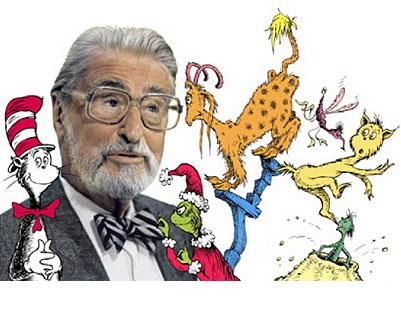
Dr. Seuss

Fellow 12 x 12er, Rena J. Traxel is participating in the A to Z Poetry Challenge for the month of April.  She asked if anyone wanted to help her out and spotlight poets starting with each letter of the alphabet.  When I saw that she chose none other than, Dr. Seuss for the letter D, I had to volunteer.


Today I was featured on Rena J. Traxel's blog talking all about Dr. Seuss.  Check it out by clicking HERE.

Thank you so much Rena for this wonderful opportunity!

Monday, April 2, 2012

Words From the Wise #7 - Emma Dryden


Two and a half years ago at the SCBWI-Los Angeles Working Writer's Retreat I had the honor and the pleasure of meeting Emma D. Dryden of drydenbks.  Not only was she a critique group facilitator, but she was also a featured faculty member.  Emma spoke about the importance of developing an online presence as a writer, and the start of ebooks for children.  I recall sitting there completely overwhelmed, and thinking that ebooks for children was a completely silly concept.  After all, what good parent would allow their children to read digitally?  If you have followed my blog at all, you know how my feelings have changed on this one.  

I invite you to enjoy Emma's thoughts as we all wish her a congratulations on the success of her company,  drydenbks, which has just celebrated its second anniversary on March 11.  Happy Anniversary Emma, and wishing you many more successful years in the world of Kidlit!


 1. Please describe your history on how you became involved in children's books.

 My parents instilled in me a great love and appreciation for books and reading. In school, I took all of the art class, English classes, and writing classes I could take. For my senior project in High School, I intended to write a picture book based on a Greek myth—which ended up being about 10,000 words!  I realized then and there that writing for children is really, really hard! In college, I wrote a lot of poetry and plays, but determined I didn’t have quite the discipline to write my own books.  I thought I might be good at helping and inspiring writers to write their books, so I set out to find an entry-level job in publishing—with a special interest in children’s books for the sake of the stories and artwork I loved so much.  Between my junior and senior years, I landed an unpaid summer internship with Viking Press Children’s Books (I was a gal Friday, doing anything anyone asked, and I soaked it all up like a sponge!) and my first job right out of college was with Random House Children’s Books, where I was assistant to two brilliant editors. And that’s how it all began.  


2.    I have discussed uTales quite extensively on this blog.  What is your involvement with uTales?  Is there anything that you can tell us about how the site will continue to evolve in the future? 

I’ve been interested in keeping my hand in anything to do with publishing children’s apps and eBooks and it’s been exciting to see the launch of the digital picture book platform, uTales.  One of the first illustrators to work with uTales brought them to my attention and I greatly admire the people behind uTales as well as the philosophy and goals for this start-up. They’ve brought me on as an editorial and publishing consultant as well as the leader of their Quality Editorial Panel, which offers feedback to uTalers about their work and oversees approvals of all the English-language uploads.  I know uTales is expanding their platform to start publishing eBooks in Swedish soon, and they intend to offer eBooks in several other languages before too long, so this truly is a global platform for authors and illustrators.  There are some terrific partnerships uTales is securing that promise to result in some very important and smart picture books. And I’m excited by the founder’s directive that uTales offer books that are entertaining as well as educational—perfectly suited for sharing between parents and children as well as between teacher and classroom.


3.    Do you feel that authors who are sticking with only traditional print publishing will be left by the wayside, especially if they are not already well established? 

Not at all.  I think traditional publishing is here to stay for a good long while yet. I do, however, think it behooves authors and illustrators to educate themselves about the various publishing options that are now open to them in order to stay savvy to changes in the marketplace. I also think there are wonderful opportunities right now for authors and illustrators to publish in a variety of formats and on different platforms without hurting themselves or their reputations in any way—and by doing so, they could thereby expand their reach to their target audience and at the same time become more adept and flexible as to how best to format, market, and produce their work. 


4.    You have spoken a great deal about the importance of social networking for authors.  Can you explain some of the ways that up and coming authors can get involved with and use social networking to their advantage?  Do authors who have well established careers need to use of social networking in order to keep up with changing trends in publishing, or will their catalogues be able to sustain themselves without it?

One of the key outcomes of the changes that have resulted in our society from so much digitization is the proliferation of companies and consumers being in direct communication with each other. We can apply this on a more personal scale when we think about how an author (or illustrator) can benefit from being in direct communication with their readership.  Social networking channels (Facebook, Twitter, LinkedIn, Google+ etc) give authors an opportunity to communicate with their readers—not so much the young readers (unless you’re a YA author), but the adults who are so important to the sale of your books: parents, teachers, librarians, bloggers, reviewers, editors, agents; not to mention, fellow authors and illustrators!  Not every social network platform reaches the same audience nor has the same results, so it’s important for authors to do their homework to determine which platform/s might best serve them and with which they’ll feel most comfortable.   Social networking is NOT meant for the hard sell, but rather for communication, a sharing of ideas, a give and take—which ultimately can and will result in people being interested in your work and in buying your books.  So saying, I feel it’s wise for pre-published authors to start gaining a good “webutation” through social networking and for published authors to retain their audience and stay attuned to new readers and new developments in the marketplace through social networking.  Always at a level of commitment that makes sense for that author.


5.    How do you think that e-books are effecting the amount of reading that people are doing?  Specifically children?  Are they replacing traditional books with e-readers, are they reading e-readers in addition to print, or are they not changing at all?

It’s not news that really young children are adept at using the devices their parents are using—smartphones and tablets—and as a result, they have access to apps and eBooks through these devices. While I can’t say if young children are reading more because of these devices, what I can say is that if they are reading at all on these devices, we may as well pay attention to puttinng the very best quality books on them.  That being said, there are a lot of studies being done to determine who is really reading on devices and how they’re reading in general—and the most recent study I’ve seen is that middle graders and teens aren’t doing a whole lot of reading on devices.  I’m not going to be the one to decide whether or not we should be letting and encouraging our children to read on devices—rather, I am of the mind that reading is excellent for children in any way they can get good books. What I am seeing most of all is more opportunities for reading for children through the availability of books (paper and boards), eBooks, and apps (and I’m talking about books on apps, not games). I don’t think digital is replacing paper and boards at all, but is simply an alternative form of delivery.  When it comes to the very young, I do believe it’s still essential there are books available that don’t make sounds or have special effects, but that simply make use of text and illsutration to stimulate a child’s imagination—I know traditionally published picture books do this; I have seen a handful of digitally published picture books do this, too.


6.    What are the 3 best pieces of advice that you can give to someone who is trying to break into the world of children's publishing? 

1. Read.   2. Write.  3. Join the Society of Children’s Book Writers and Illustrators (SCBWI).  Read as many children’s books as you can—read them silently; read them aloud. Look at the jacket artwork. Look closely at the illustrations. Listen to the voice. If you’re a picture book author, read picture books, of course, but also read some poetry, middle grade, YA, and non-fiction. If you’re a YA author, read YA, of course, but also read some middle grade and picture books.   Write as much as you can. Experiment with your writing, trying different perspectives and points of view. Write a scene only in dialogue. Write a paragraph and then try to rewrite it in one sentence. Play with language. Just keep writing.  And join SCBWI– a global organization that offers resources, information, support, and community to children’s book authors and illustrators.https://mail.google.com/mail/images/cleardot.gif


Emma has been part of the children's book world for 25 years.  She has edited almost 500 children's books of all genres.  Her titles have included books that have become Newbery Medal, Caldecott Honor, and Coretta Scott King Author Honor books, just to name a few.  Emma is currently on the SCBWI Board of Advisors, as well as the head of the uTales Quality Editorial Panel.


Thursday, March 29, 2012

Time for Me to Stop at the Pump

I am absolutely loving all of the different writing contests that are in full swing right now. The people that I have digitally met (I have not met any of you in person yet and would love to, so if you are ever in LA please let me know), and the support that I have found are unbelievable. PiBoId month in November got my wheels turning, and 12 x 12 in 2012 has gotten my vehicle to drive forward.  However, I am feeling like I am running out of gas and it is only March.


As I sit here at my desk I am looking at my lists that are taped on my wall and feeling overwhelmed.

  • I have one that is my ever expanding topics from PiBoId (even though November is over, I continue to add to the list).  
  • I have one that is a month by month listing of the drafts that I have written for 12 x 12.  I have one that outlines which manuscripts I have submitted to which agents and the date that I should be expecting to receive their rejection.  
  • I also have a list of who I am critiquing and who I am waiting on for critiques from my critique group this round.  


Now I feel like I really should do something with all of these lists.  I have so many stories running through my mind, that I am having difficulty knowing where to focus my attention so that I can really edit.  Editing is the part of writing that I enjoy the most, and I have so many things to edit that I don't know where to begin.

I know that I have dedicated this school year to writing, and I have done a very good job of sticking to that.  For me, however, it is time to stop at the pump, refuel, and get on with this challenging, uphill drive.  I will never make it to the top of the mountain unless I step on the gas.


Monday, March 26, 2012

Words From the Wise #6 - Jez Alborough

I must say as we are entering week 6 of Words From the Wise, I have learned an incredible amount from all of the very talented people that I have had the pleasure of interviewing.  I hope that you have all been enjoying this feature, and will continue to enjoy in the weeks to come.  As always, if you have someone who you are interested in meeting here, or would like to be featured yourself, please let me know.

Today we are honored to learn all about author/illustrator, Jez Alborough.  Since 1984 we have all enjoyed his picture books about animals.  His books have helped us all to smile, laugh, cuddle our children, and to learn from his craft.  This year he comes out with his latest book, Six Little Chicks.  He also has a newly revamped portion of his website called The Club.  Be sure to check it out and to join.

Without further ado, here is a guest post by Jez Alborough. . . take it away!


I have two fantastic jobs: writing children’s books and illustrating them. My wife came up to my studio at the top of our house last week and found me cutting, folding and sticking pieces of card to create a paper engineering version of the dashboard of a truck belonging to a Duck. I had spent all day finding a way to have the movement of a tab change the gears, raise the needle on the speedometer and the engine temperature gauge. She looked at me as I sat there, tugging at the tab - driving my make believe truck and said: "You just sit up here and play all day."

How I spend my time now is not that dissimilar to how I spent it as a child - drawing and making up stories. Nowadays however I do it at a desk instead of lying on my belly with my feet waving in the air. Back then, when I wasn’t outside playing football (my other great love as a child) I could be found inside, spread-eagled on the carpet creating a football match in two dimensions with a pen, a sheet of paper and a fertile imagination. As I sketched my favourite players displaying their skills – with correct kits, haircuts and facial likenesses - I would speak the words of the imaginary commentator: ‘it’s Charlie Cooke... just look at him - weaving through the defence... past Bremner, past Peters, and he’s through...’ Then, as I scribbled in the circles representing the distant faces in the grandstand (a trick learnt from SHOOT magazine) I would give voice to the roar of the crowd reacting to Charlie Cooke’s break for the goalmouth.

Later I started drawing my own made up characters using a repertoire of funny voices to express out loud what I Imagined they were saying to each other. Giving them the power of speech added a whole new dimension to the creation; it made the characters as real as they were in my head - and it was a lot more fun.

Using a convention I had learnt from Dennis the Menace in the BEANO I started writing down what they were saying in speech bubbles above their heads. In retrospect I can see that comics were my first teachers on the road to being a children’s book author and illustrator. Comics gave me a graphic vocabulary which I still use today; they taught me how to break up the story into important scenes and how to compose these scenes within a frame. Most importantly I learnt how beautiful a simple black line can be when it is drawn with the confidence to allow a certain amount of relaxation.

As I grew up I used every opportunity to practice my love of drawing and story telling. At primary school I remember the excitement of finishing an exercise book because this became a passport to get me into the Aladdin’s cave of the stockroom to obtain a new book. Some artists talk about the fear of a blank page of paper but to me it has always been an exciting invitation to catch with my pen the images and ideas that were floating about in my head.
What I treasured most amongst the pens, erasers and sugar paper were those exercise books which had ruled pages on one side and blank pages on the other. For me these were an invitation to create my first picture books. Now my character’s speech would appear in a block of text opposite the illustrations. I recall Custer, with long flaxen hair and droopy moustache being the hero of one of these early books – the influence of a television series. I don’t recall showing these books to my teacher or parents - they were made solely for my own enjoyment, for the pure pleasure of play.
This same principle applies to the books I create today. The best stories come out of a pure sense of play – without thoughts of how they might be received by an audience. These more grown up considerations come later. The first stage is purely selfish; I’m making a book simply because I love doing it.
Having mentioned comics and T.V programmes as sources of inspiration for my creativity (lets not forget TOP CAT) I would like to be able to reel off the names of many treasured picture books which had enriched my development. The truth is, back in the early sixties there simply wasn’t the array of fantastic 32 page works of art that bookshops are bursting with today. I do remember the poems and drawings in WHEN WE ARE SIX by A.A. Milne (thank you whoever brought that into our home) and a book of riddles by (Bennet Cerf?) illustrated with beautifully simple brushline drawings. Years ago, just before giving a reading to a group of children in a library, I found a copy of this book on the shelves. As I scanned the graceful drawings which I hadn’t seen for decades I realised that I knew every brushstroke by heart. As a boy I had the memorised lines just as faithfully as if they had been lines from a favourite poem. I hadn’t just seen the pictures, I had read them, and the language I had learnt from studying was utilized in my drawings and still is today.
After school I spent three years at Art College – accompanied the whole time by a succession of sketch books. These were whipped out at every opportunity to record the minutiae of student life in drawings. Any interesting, quirky things being said would be scribbled underneath or in a speech bubble. Once again the words helped to bring the picture to life.
I have always been interested in the marriage of words and pictures and it is this fascination which informs my work today. I am lucky in that if I have a story to tell - I have two versatile and complementary tools with which to tell it. With picture books the fun comes in deciding what you tell in words and what is best said in the language of pictures.
In my book Hug it became clear to me that my story was best told by the pictures (I cut the text down to only three words!) This meant that the pictures had to carry most of the story development. The expressions on the character’s faces, the body language, the colours, the compositions all had to work together to give the information which the child would need to engage emotionally with the twists and turns of the story. My central character in the book is a chimpanzee called Bobo (yes, one of the three words in the book). In the story Bobo’s sense of lostness and bewilderment at losing his Mum has to grow page by page. If this is conveyed convincingly then the reader will identify with Bobo and hopefully feel the same sense of joy and relief as he does when he is reunited with his Mummy (you may have guessed the third word by now). The emotions on Bobo’s face are therefore crucial to the story. When you consider that the raising or lowering of a line describing a mouth by as much as a millimetre can radically change an expression (and therefore the emotion of the character) things can get a bit scary. If I thought about this sort of thing too much I could never put pen to paper.
When you are writing and illustrating for children you have the pleasure of knowing that you have the most attentive audience for your work. Even if children are not yet able to read the words they are nearly always fluent readers of the pictures. They will read the lines and interpret the expressions on the faces. In this respect they are often better readers than their parents - who will miss many details that the child is instinctively picking up on.
One of the things I love about being an illustrator is that there are so many different materials that can be used to make pictures. For me to use only ink and line in my illustrations would be like a musician only ever playing one type of music. Why play just classical when there’s jazz, blues, boogie woogie and many other styles to explore? In my book Some Dogs Do I used gouache paint with no line at all and in Guess What Happened at School Today (a collection of my poetry) I used coloured paper to make collage illustrations. By ripping, cutting, sticking, splodging, scratching, and scrawling my way through varied mediums I find that I get to express different aspects of myself as an artist.
So I confess, it’s true: I do play for a living. I’ve been getting away with it for twenty years now and no-one’s blown the whistle for playtime to end yet!


Jez’s new picture book  6 LITTLE CHICKS has just been published, to find out more please go to ; jezalborough.com/theclub